Amethyst: the Heart-Conqueror Diva
When it comes time to talk about Amethyst, historical images are immediately evoked, in the swirl of legends and myths in which she is the protagonist.
She is the Diva of the Quartz family.
She has her own way of showing off in jewelry stores and bragging about having made Dionysus, the God of wine, fall in love with her. Unfortunately for her, Dionysus was a hot-tempered fellow and turned her into a Gem after being rejected by the damsel.
Gem-quality Quartz varieties are abundant on Earth, but the one that continues to capture the spotlight in jewelry stores is always Amethyst. The word Amethyst anciently meant “one who cannot get drunk”. So if you find yourself dealing with tipsy types, it’s best to always wear one as a precaution.
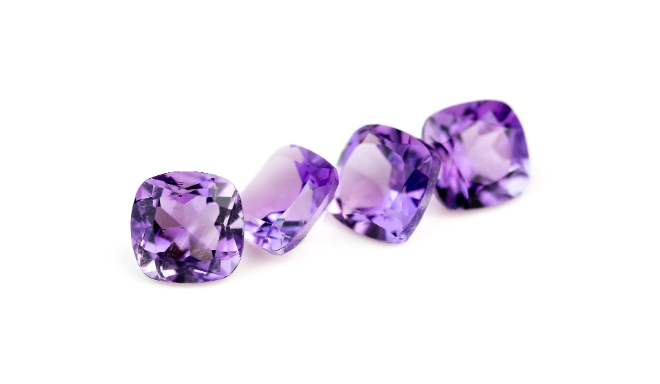
Amethyst is the Gem most immediately associated with the color purple, even though there are also Sapphires and Tanzanites of this color. It is the Gem of February and the 6th wedding anniversary.
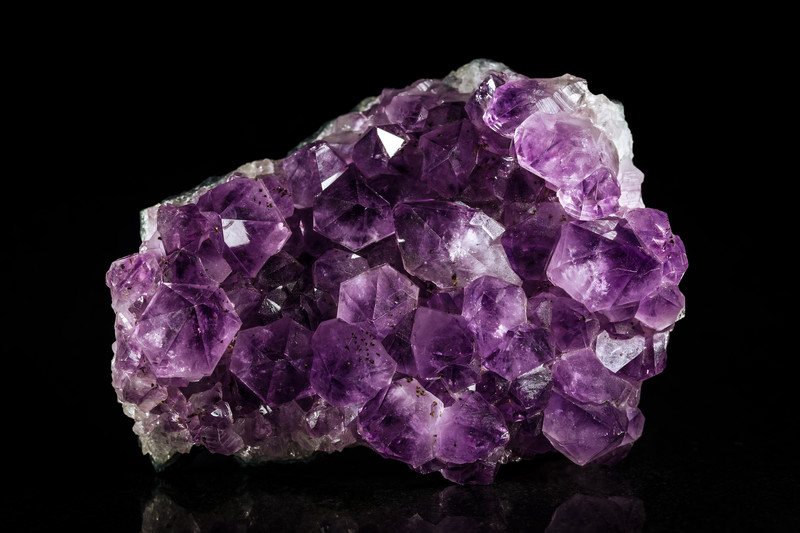
Amethyst belongs to the group of large Quartz crystals. Until the 19th century, Russia was the only source of Amethyst, but the aura of rare Gem disappeared as soon as a huge source was discovered in Brazil. Right after the discovery of the enormous Brazilian deposits, Amethyst prices plummeted, making this Stone with such an elegant color a commercial Gem suitable for mass jewelry.
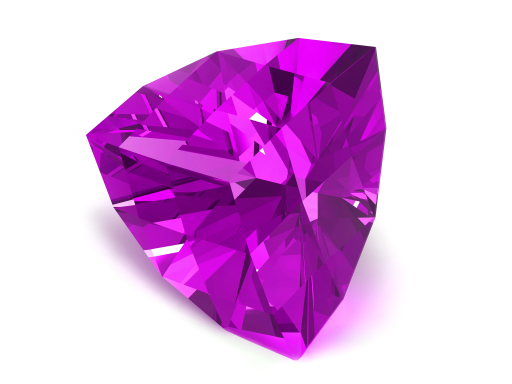
Zambian, Maraba and many more!
In addition to the legendary Zambian Amethysts and the Maraba ones mined in Para, an Arizona mine that had been inactive for 20 years recently re-emerged: the Four Peaks Mine. The American mine produces Amethysts of both high and commercial quality.
Minor sources of Amethyst include: Canada, India, Madagascar, Mexico, Myanmar, Namibia, Sri Lanka and Tanzania.
India and Thailand cut most of the commercial rough.
High-quality rough is instead cut in the famous German town of Idar-Oberstein.
Absolutely fascinating is the Lampivaara Amethyst Mine, set in the perpetually Christmassy scenery of Lapland; no less evocative is the Blue Point Amethyst Mine in Ontario, Canada.
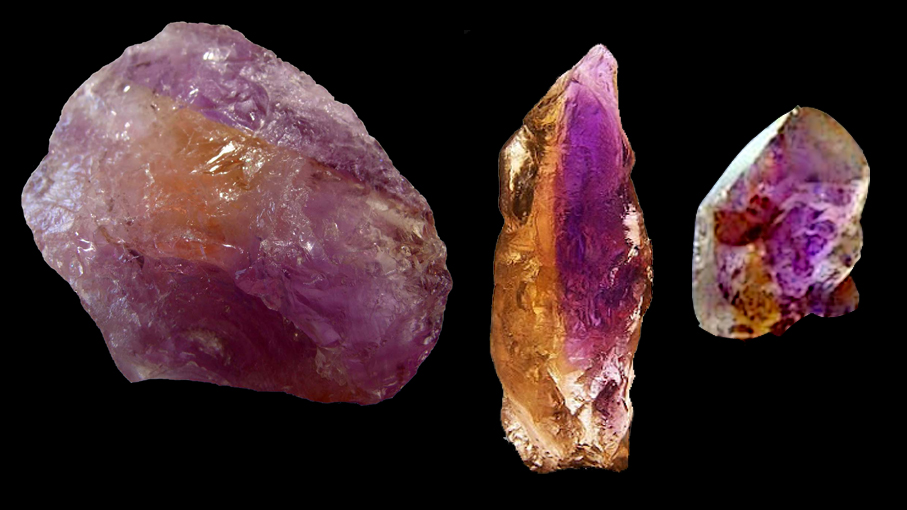
Ametrine, child of Amethyst!
Yes indeed, Ametrine is a transparent, bi-colored variety of Amethyst that reveals itself in light with the colors of both Citrine and Amethyst. And it is the charm of nature, with its not-always-equal and homogeneous distributions, that makes the Anahi mine the only source of Ametrine in the world.
This incredible mine is located 150 km north of Puerto Suarez, near the Brazilian border, which is why Ametrine is nicknamed by friends “Bolivianite”.
Ametrine forms under incredible and unlikely geological conditions.
Sudden temperature changes and perfect combinations of chemical elements simultaneously give these two unusual colors to a single Gem.
During the first Spanish expedition to eastern Bolivia, the soldier Felipe de Urriola y Goitia came into contact with the peaceful Ayoreo tribe. He soon lost his head madly for the chief’s daughter: Princess Anahi.
Don Felipe asked for Anahi’s hand, and the chief, despite his evil advisors pointing him toward another choice, granted it.
Moreover, the chief gave the mine to his daughter and to Don Felipe, in defiance of the advice received.
Don Felipe was not very interested in the mine, but not so much for ethical or moral reasons, rather because at that time the Spanish conquistadors paid more attention to gold, silver and Emerald mines.
Unfortunately, we still don’t know if the love between Anahi and Don Felipe was real..